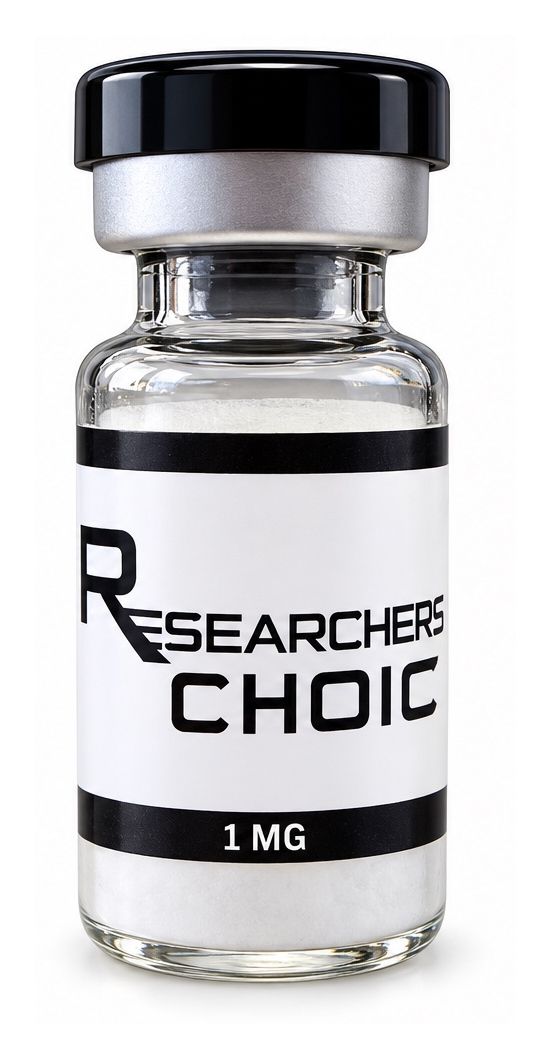
FOLLISTATIN 344 95% 1MG (LYOPHILIZED POWDER VIAL ONLY)
$124.95
CUSTOMER COMMENTS / SUGGESTIONS / REQUESTS
Enter your text
Estimated delivery time
Shipping: today or tomorrow
Pickup: today, 04:50 PM–06:30 PM
In stock: 1 available
Save this product for later
Customer reviews
Reviews only from verified customers
No reviews yet. You can buy this product and be the first to leave a review.
Have questions?
FOLLISTATIN 344 95% 1MG (LYOPHILIZED POWDER VIAL ONLY)
Product Details
Brand: RESEARCH'S CHOICE
This is educational and research discussion only. Not medical advice
Key Characteristics of Follistatin 344 (95%) (1mg)
- Human Follistatin Isoform–based Reagent: Matches a 344–amino-acid human follistatin form, a secreted protein known for binding several TGF-β family ligands—especially activins.
- High-Affinity Activin and Myostatin Binding: Forms stable complexes with activin A and also binds myostatin (GDF-8) and related ligands, which blocks receptor binding and reduces signaling.
- Tool for SMAD2/3 and Downstream Signaling Research: By limiting ligand–receptor interaction, it helps researchers study changes in SMAD2/3 activation and downstream transcription programs in muscle, liver, and other tissues.
- Muscle Growth and Strength–Related Models: Research uses follistatin-based tools to explore how inhibiting myostatin/activin pathways can affect muscle differentiation, fiber characteristics, and strength-related endpoints in preclinical systems.
- Applications in Fibrosis, Oncology, and Liver Biology: Studies examine the activin–follistatin balance in models of liver fibrosis, tissue scarring, and tumor cell behavior, where activin signaling can influence growth and remodeling pathways.
- Research‑Grade, 95% Purity Presentation: Supports smaller studies, pilot work, and method development while providing a defined purity level appropriate for controlled assays.
- Lyophilized Format for Stability: Freeze-dried powder supports storage and transport stability until reconstitution for experimental use.
How Follistatin 344 (95%) (1mg) Supports Research
Researchers mainly use Follistatin 344 to reduce activin and myostatin signaling in controlled models. When it binds these ligands outside the cell, it lowers their ability to activate receptors such as ActRIIA and ActRIIB, which can shift SMAD2/3 signaling and gene expression.
In skeletal muscle studies, researchers use follistatin-based reagents to investigate how reduced activin/myostatin signaling influences muscle differentiation and growth-related readouts in preclinical systems. In liver and fibrosis research, investigators study the same pathway balance for links to stellate-cell activity, cell survival, and tissue remodeling markers. Developmental and oncology models also use follistatin tools to explore how activin-linked signaling shapes cell growth, migration, and patterning.
Across all applications, Follistatin 344 functions as a pathway probe rather than a therapeutic agent.
Research Applications & Usage Information
Follistatin 344 (95%) (1mg) is commonly included in laboratory studies focused on:
- Myostatin/Activin Signaling and Muscle Biology: Neutralize ligands in muscle cell and animal models to examine differentiation, hypertrophy-related endpoints, and pathway-specific effects.
- TGF‑β/SMAD Pathway Mapping: Measuring how reduced activin availability changes SMAD2/3 activation, transcriptional outputs, and signaling cross-talk within the broader TGF-β superfamily.
- Tissue Regeneration and Remodeling Models: Studying in extracellular-matrix markers, inflammatory signals, and remodeling responses in muscle, liver, and other tissues.
- Oncology and Tumor‑Biology Research: Explored how shifts in activin–follistatin balance relate to tumor-cell behaviors such as proliferation, invasion, and survival in defined models.
- Developmental and Embryology Studies: Modeled ligand antagonism in embryology systems where activin/BMP signaling influences early development and organ formation.
- Endocrine and Metabolic Pathway Investigations: Investigated how changes in activin-linked signaling relate to endocrine readouts in preclinical systems (mechanistic work only).
In all cases, the outcomes observed are specific to the experimental systems used and should not be extrapolated to clinical practice. The peptide is a research‑only reagent intended for in‑vitro, ex‑vivo, and animal‑model studies under controlled conditions.
Research Use Only Notice
This product is intended for laboratory research use only and is not approved for human or veterinary use. It is not intended for diagnostic, therapeutic, or clinical applications. Any reference to biological activity or potential effects is based solely on preclinical or in-vitro findings and should not be interpreted as validated clinical outcomes. Researchers are responsible for ensuring proper handling, storage, and disposal in accordance with institutional, federal, and international guidelines.
Follistatin-344 is a naturally occurring glycoprotein involved in regulating myostatin and activin signaling. It's significantly larger and more complex than most peptides discussed in this sub made up of 344 amino acids. Your body already produces follistatin naturally. Research products marketed as follistatin-344 are intended to mimic or deliver the native protein sequence but human injectable data is extremely limited
WHAT IT DOES
Follistatin works by binding and neutralizing myostatin. Myostatin is the protein your body uses to limit how much muscle you can build. Think of it as a ceiling on muscle growth. Follistatin removes that ceiling
It also binds activin A which has additional growth suppressive effects on muscle tissue
By blocking myostatin and activin follistatin may allow enhanced muscle hypertrophy and activate satellite cells which are the muscle stem cells responsible for repair and growth
This mechanism is distinct from GH secretagogues and anabolic compounds. GH peptides add a growth signal. Anabolics work through androgen receptors. Follistatin removes a growth inhibitor. That makes it complementary to other compounds not redundant
THE EVIDENCE PROBLEM
This is where it gets complicated
The best human evidence comes from AAV1-FS344 gene therapy studies in muscular dystrophy not from injectable peptide protocols. The Becker muscular dystrophy gene therapy trial used AAV1.CMV.FS344 and reported improved 6 minute walk distance with a reasonable safety profile
Primate studies showed 15% muscle growth persisting for over 15 months using gene therapy delivery
The critical distinction is that gene therapy provides sustained local expression of follistatin over weeks and months. An injectable peptide clears much faster based on available animal pharmacokinetic data though human subcutaneous half life for injectable FS344 specifically is not well established
The biology is real and well studied. The injectable peptide delivery method in humans is not. Community dosing protocols are extrapolated from gene therapy and animal data not from controlled human injection trials. That distinction matters when deciding whether to run this compound
DOSING
Because there are no controlled human dose finding trials for injectable follistatin-344 dosing discussions are anecdotal and experimental
Conservative start - 100mcg subcutaneous daily for a 10 day cycle
Common range - 100 to 200mcg daily for 10 to 30 days
Training day protocol - some protocols use 50mcg intramuscular 30 minutes before training on training days only. 8 weeks on 8 weeks off. The idea is to target myostatin inhibition around resistance training when it matters most
Cycle - 10 to 30 days on followed by 3 to 4 weeks off
Why short cycles - the off period allows the body's myostatin and follistatin axis to re-equilibrate and provides a safety window to monitor for side effects
IM injection sites include deltoid, outer thigh, or upper outer glute. Sub-Q abdomen works for the daily protocol
Start at 100mcg daily for a 10 day cycle. Assess before extending to longer cycles or higher doses
These are community and practitioner derived protocols not evidence based recommendations
WHAT TO EXPECT
Week 1 to 2 - some people report noticeable strength and fullness gains within the first two weeks. The compound is discussed as working relatively fast compared to most peptides
Week 2 to 4 - continued lean mass and strength improvements reported if training and nutrition are in place
Results are going to be highly individual. This is an experimental compound with minimal human injection data. Some people respond strongly. Others may not notice much. Expectations should be tempered by the lack of controlled human evidence for this delivery method
SIDE EFFECTS
Limited human safety data exists for the injectable form
Reported concerns include:
- Potential effects on fertility during use. Follistatin binds activin which plays a role in FSH regulation and reproductive tissue signaling. This is why cycling off is important
- Injection site reactions
- Unknown long term effects from repeated myostatin suppression
- Theoretical concerns about effects on other tissues where activin signaling matters
The gene therapy trials showed a reasonable safety profile but those involve a different delivery method in a different population than healthy adults using injectable peptides
FOLLISTATIN-344 VS FOLLISTATIN-315
FS-344 is best described as the isoform used in the gene therapy program. FS-315 is the primary circulating form most relevant for muscle effects. FS-288 binds more tightly to cell surfaces and is more concentrated in reproductive tissues which is where the fertility concerns come from
Research vendors typically sell FS-344 as it is the form most commonly referenced
HOW IT COMPARES
Follistatin vs GH peptides (CJC/Ipa, Sermorelin) - different mechanisms. GH peptides add a growth signal through growth hormone elevation. Follistatin removes a growth inhibitor. They can be run together without overlapping pathways
Follistatin vs IGF-1 LR3 - IGF-1 drives protein synthesis and satellite cell activation. Follistatin removes the brake on growth. Different mechanisms
Follistatin vs anabolics - anabolics work through androgen receptor activation. Follistatin works through myostatin inhibition. Different pathways
Follistatin vs ACE-031 - ACE-031 was a pharmaceutical attempt at myostatin pathway inhibition that showed lean mass signals in phase 1 but was discontinued in phase 2 due to adverse events including nosebleeds and telangiectasias. Follistatin takes a different approach to the same target
COST
One of the most expensive peptides you can run. Follistatin is a large complex protein that's difficult and costly to manufacture. A single cycle can run several hundred dollars depending on dose and duration. Factor that in before committing
WHO IT'S FOR
People who have pushed natural muscle building as far as it goes and want to explore beyond genetic limits
People running advanced protocols who understand this is experimental with minimal human injection data
People willing to cycle properly and monitor for side effects
People whose training and nutrition are already dialed in. Follistatin isn't going to fix a bad program
WHO IT'S NOT FOR
Beginners. This is not a starting compound
People who aren't willing to accept the risk of using something with very limited human data
People concerned about fertility effects during use
People looking for a cheap addition to their stack
IMPORTANT
Follistatin-344 is investigational. Human data comes from gene therapy studies not standard injectable peptide protocols. No FDA approved performance enhancement use exists. Community dosing is extrapolated from preclinical and gene therapy data. Treat this as an experimental compound with promising biology but incomplete evidence for the injectable delivery method
This is educational and research discussion only. Not medical advice
FOR RESEARCH USE ONLY!
Athletic Restrictions: The compound is prohibited by the World Anti-Doping Agency (WADA).
Step-by-Step Reconstitution
To reconstitute a 1mg vial of Follistatin 344, researchers typically mix the lyophilized (freeze-dried) powder with bacteriostatic water (BAC water, 0.9% benzyl alcohol): [1]
- Choose a Diluent Volume:
- Clean the Workspace: Wash your hands thoroughly and wipe the rubber stoppers of both the peptide vial and the BAC water vial with a fresh 70% isopropyl alcohol prep pad. Allow them to air-dry for about 30 seconds. [1]
- Draw and Add Water: Draw the chosen amount of bacteriostatic water into a sterile syringe. Slowly insert the needle through the rubber stopper of the Follistatin vial. [1, 2]
- Dissolve the Powder: Inject the water slowly down the inside wall of the vial (or direct it toward the powder depending on protocol). Gently swirl or roll the vial—do not shake—until the powder is completely dissolved into a clear, colorless solution. [1, 2, 3]
- Inspect: Check that the solution is clear and free of particles or cloudiness. Discard the vial immediately if it appears cloudy or discolored
| 1-2 | 50-100 | 2x/week | Baseline tolerance assessment |
| 3-4 | 100-200 | 2x/week | Monitor for injection site reactions |
| 5-6 | 200-300 | 2-3x/week | Evaluate response markers |
| 7+ | 300-500 | 3x/week | Maximum research doses |
You May Also Like
Display prices in:USD